
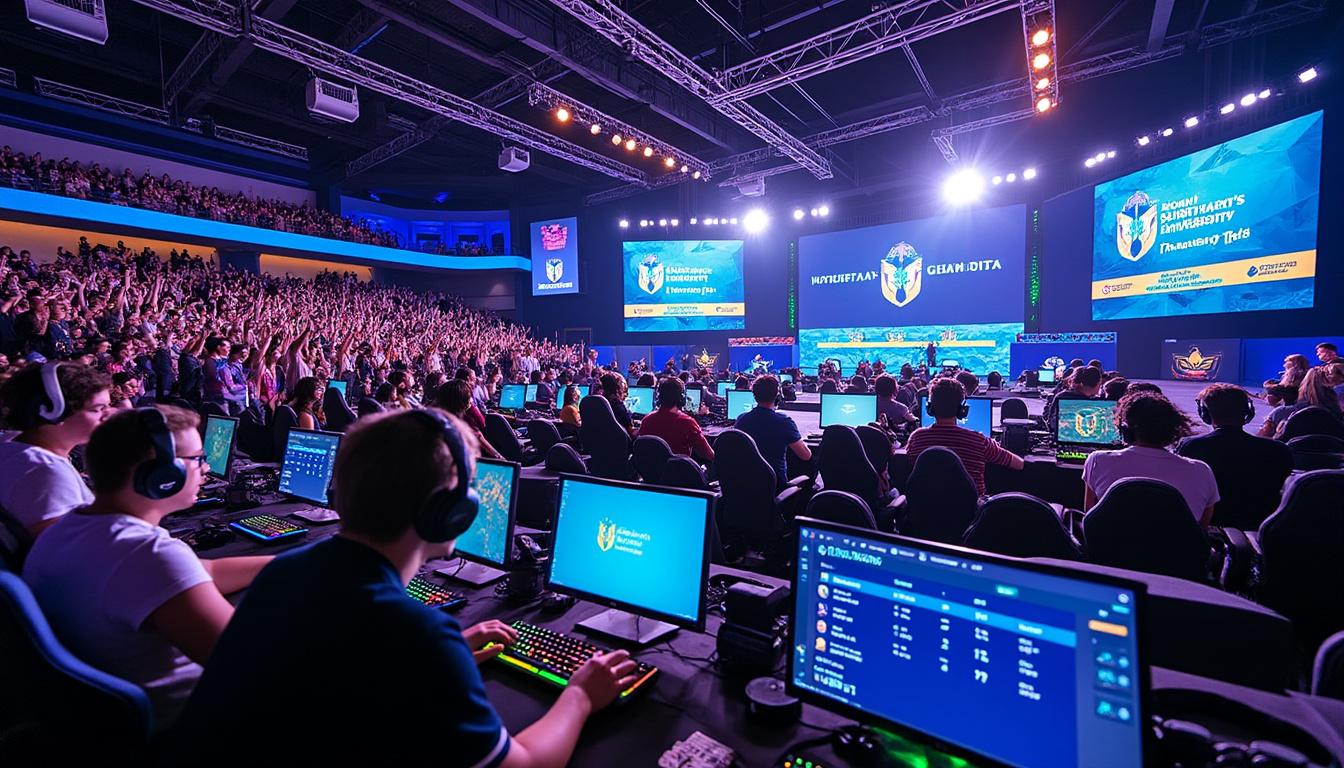
Mount Saint Mary’s University turned Knott Arena into a full-scale Esports Championship stage, with chants, clutch finishes, and more than 100 student gamers competing across five titles.
In brief:
- Mount Saint Mary’s University hosted the MAAC championship event for the first time since the competition began in 2019.
- The weekend ran from Friday through Sunday and featured over 100 players from 13 colleges.
- Games on the schedule included Rocket League, Overwatch 2, Super Smash Bros. Ultimate, League of Legends, and Valorant.
- Sunday delivered the final results: Siena won League of Legends, Quinnipiac took Rocket League and Overwatch, Iona claimed Smash, and Fairfield won Valorant.
- Mount teams did not reach the finals, but their runs still marked program progress with a semifinal in Rocket League and a quarterfinal in Smash.
- The winners earned the right to advance to the Collegiate Esports Commissioners Cup in San Antonio in May.
Mount Saint Mary’s University Hosts A Breakout Esports Championship
Knott Arena looked nothing like a basketball venue by Sunday morning. The noise was there, the pressure was there, and the crowd energy was there too, but all eyes were locked on the stage screens instead of a rim.
That shift mattered. Mount Saint Mary’s University stepped in as university host for a major gaming event, and the result felt bigger than a simple venue change. It felt like college esports planting its flag in a space that traditional athletics usually owns.
The event brought together the final wave of teams from the Metro Atlantic Athletic Conference esports circuit. After years of growth since the league launched in 2019, this inaugural event at the Mount gave the championship a fresh in-person identity. And yes, that matters when programs are fighting for visibility, recruiting, and campus support.
Why This Inaugural Event Mattered Beyond One Weekend
Plenty of schools say they care about competitive gaming. Fewer back it up with a full championship setting that looks and feels legit. Mount Saint Mary’s cleared that bar.
More than 100 players from 13 colleges showed up across a three-day esports tournament. That kind of turnout is not some side-room LAN with folding tables and a Discord announcement. It signals that the conference scene is growing into something with structure, stakes, and momentum.
And the timing is good. In 2026, more schools are treating esports closer to varsity athletics than club hobby space. Small scholarships, dedicated coaching, branded streams, and clearer competitive pathways are no longer rare. If that sounds familiar, it is because the wider scene has been moving this way for years, much like the trends covered in top esports in 2025.
The hidden win here is campus legitimacy. Once a university arena hosts a serious video game competition, it becomes harder for anyone to dismiss the scene as kids mashing buttons in a basement. That outdated take has been losing for a while, and weekends like this bury it further.
The competitive side was not lacking either. Most brackets were razor close by the end of Saturday, which gave Sunday the kind of tension every event organizer wants and every player half hates, half lives for.
Five Titles, Five Different Kinds Of Pressure
The championship featured five games, and that mix says a lot about where the collegiate scene sits right now. It was not built around one genre or one publisher. The lineup covered team shooters, a MOBA, platform fighting, and car soccer chaos, which is still one of the funniest accurate descriptions of Rocket League.
- League of Legends
- Valorant
- Overwatch 2
- Rocket League
- Super Smash Bros. Ultimate
That variety changes the atmosphere inside the arena. A Smash set creates pure nerves and crowd gasps. Rocket League gives those instant momentum flips where one mistake turns into a zero-second heartbreak. League and Valorant bring more layered team calls, drafts, utility, and long-form pressure. Overwatch sits somewhere in the middle, usually one teamfight away from chaos.
For fans, that means the weekend never feels flat. For players, it means the conference has built an ecosystem instead of hinging the whole identity on a single title. Smart move.
The Full Championship Results From Sunday
By the time Sunday started, nearly every bracket had reached its final pairing. Only Overwatch still had semifinal business to finish, which added a bit of extra scheduling chaos. Nothing says esports like one title refusing to follow the neat script.
Here is how the winners shook out:
- Siena University defeated Iona University in League of Legends
- Quinnipiac University defeated Fairfield University in Rocket League
- Quinnipiac University defeated Marist University in Overwatch
- Iona University defeated Manhattan University in Super Smash Bros. Ultimate
- Fairfield University defeated Manhattan University in Valorant
That spread of winners is good for the league. No single program walked in and farmed every title. Instead, different schools found their edge in different games, which makes the conference feel more competitive and less solved.
League fans will notice Siena over Iona as a headline result. For readers who follow broader Riot competition, the appetite for organized play keeps growing at every level, from campus brackets to global circuits covered in pieces like League of Legends esports championship. The scale is different, but the pressure is familiar.
Every title also showcased a different kind of player stress. Team communication in Valorant or Overwatch can collapse off one bad mid-round call. Smash flips everything onto one player’s hands. And those hands tend to shake when a championship set comes down to the last stock.
Mount Saint Mary’s Did Not Win It All, But The Program Still Moved Forward
There is a lazy way to cover host schools in an event like this. It usually goes something like: they fell short, but the experience was valuable. That line says nothing. The better read is that Mount showed measurable progress even without a finals appearance.
The school fielded teams in Rocket League and Smash Bros. Neither reached championship Sunday’s last step, but both finished deeper than in previous runs. The Mount reached the Rocket League semifinals and the Smash quarterfinals. For a program trying to establish itself, that is not fluff. That is movement.
Head coach Michael Hansen Jr. made the key point after the event. Aside from Overwatch, the brackets were tightly contested, with close endings, swings in momentum, and upsets that came down to tiny margins. Anyone who has watched enough collegiate brackets knows that a clean semifinal run can turn into a title the next season if the core stays together and recruiting hits.
What The Host School Performance Says About College Esports Growth
Progress in collegiate competition rarely looks glamorous at first. It looks like quarterfinals turning into semifinals. It looks like a program getting more organized behind the scenes. It looks like more players believing the school takes the scene seriously.
That is what made Mount’s weekend meaningful. The host role gave the program visibility, but the deeper runs gave it credibility. Those are not the same thing.
And if you have watched smaller esports programs build from scratch, you know this pattern. A team gets one solid result, attracts better tryout talent, tightens coaching, and suddenly the next season is not about showing up. It is about who they can upset. That is how sleeper programs stop being sleepers.
The bigger point is simple. Hosting an esports tournament is good branding. Competing better while hosting is stronger proof that the school is building something real.
The Human Side Of The Championship Hit Hardest In Smash
The cleanest example of championship pressure came from the Smash finals. Iona junior Michael Roman secured the title after a close one-on-one finish against Manhattan grad student Elias Lopez, and the reaction said everything. Roman’s hands were still shaking after the match.
That detail lands because it cuts through all the polished branding around competitive gaming. Under the lights, this is still about players trying to hold it together while teammates, coaches, and classmates depend on them. Anyone who has thrown a set from nerves knows the feeling. Your inputs get weird, your brain races ahead of the game, and suddenly even easy confirms feel cursed.
Roman used Terry from Fatal Fury, while Lopez picked Robin from Fire Emblem. It was not just a character matchup. It was a mental matchup shaped by history, because Roman had lost to Lopez many times before and expected more of the same. Instead, he finally got over the line in the highest-pressure spot possible.
Why Team Pressure Feels Different In A Video Game Competition
Roman’s post-match comments got to the core of why college events hit different. The pressure did not come only from the game. It came from knowing other people were relying on the result.
That is the part non-players miss. In solo queue, losing feels bad. In a campus final, losing can feel like letting down the whole room. The emotional load is heavier because every round carries team points, school pride, and months of preparation.
Lopez explained his side too, and it was brutally relatable. He was not just trying to win. He was trying to win while preserving enough points, and that extra mental stack caught up with him. That is esports in one sentence. One layer too many, one second too late, set over.
These moments are why college esports works when it is presented well. The emotion is real, the stakes are clear, and the audience does not need patch-note knowledge to feel the tension.
For readers who track how the scene keeps broadening, this kind of story is also why youth and campus competition matters so much. The path from student bracket to wider esports visibility is more established than ever, and that pipeline has been part of the conversation in stories around school-level esports growth.
What Comes Next After The Gaming Event In Emmitsburg
The winners from Sunday earned the right to send teams to the Collegiate Esports Commissioners Cup in San Antonio this May. That changes the meaning of the conference title. It is not just local bragging rights. It is a qualifying step into a wider national spotlight.
That kind of progression is one reason schools invest at all. A conference championship gives programs a visible goal. A national event gives them a reason to build beyond one semester and one roster.
There is also a recruiting angle here that should not be ignored. If a high school player sees a university hosting an arena event, offering support, and sending champions onward, that school moves up the list. Fast. This is how institutions compete for talent in 2026, and esports is part of that now whether old-school administrators like it or not.
How Universities Are Treating Student Gamers More Like Varsity Athletes
Michael Hansen Jr. pointed to a trend that keeps getting stronger. Schools in the MAAC, including the Mount, offer small scholarships to esports players. That will sound normal to anyone deep in the scene, but it still surprises people outside it.
The shift is not random. Universities have figured out that esports supports recruitment, community, retention, and branding all at once. Few campus activities can pull in a live crowd, an online audience, and a competitive structure across multiple games with this kind of consistency.
And no, scholarships do not mean every roster instantly becomes cracked. But they do change the seriousness level. Once money, coaching, and travel are in the mix, players treat prep differently. Review gets sharper. Attendance gets cleaner. The old stereotype of disorganized club play starts to disappear.
That is why this inaugural event hit harder than a one-off weekend. It reflected a category of competition that now sits in a real middle ground between campus culture and formal athletics.
Why This Esports Tournament Felt Like A Sign Of Where The Scene Is Going
There is a reason events like this get traction with students and schools at the same time. They are easy to understand. Teams represent campuses. Crowds get behind logos and rivalries. Winners move on. The format works because sports logic transfers cleanly into digital competition.
But the better takeaway is the atmosphere. The loud reactions inside Knott Arena showed that audiences do not need a giant publisher-backed production to care. They need stakes, identity, and matches that are not boring. This weekend had all three.
For the MAAC, the result is momentum. For Mount Saint Mary’s, it is proof that serving as university host can lift both the school and the conference brand. For the players, it is one more signal that student gamers are no longer playing on the margins of campus life.
And for anyone still asking whether collegiate esports has a future, that question is getting stale. The better question is which schools are moving fast enough to keep up.
What games were played at the Mount Saint Mary’s University championship event?
The championship featured five titles: League of Legends, Valorant, Overwatch 2, Rocket League, and Super Smash Bros. Ultimate. That mix gave the event a broad college esports feel rather than centering everything on one game.
Did Mount Saint Mary’s University win any titles as host?
No championship titles went to the host school, but Mount still showed progress. Its Rocket League team reached the semifinals and its Smash team made the quarterfinals, both stronger finishes than in prior runs.
Why was this inaugural event important for college esports?
It gave the MAAC championship a high-visibility in-person setting, brought together more than 100 players from 13 colleges, and reinforced how universities now treat competitive gaming with more structure, support, and legitimacy.