
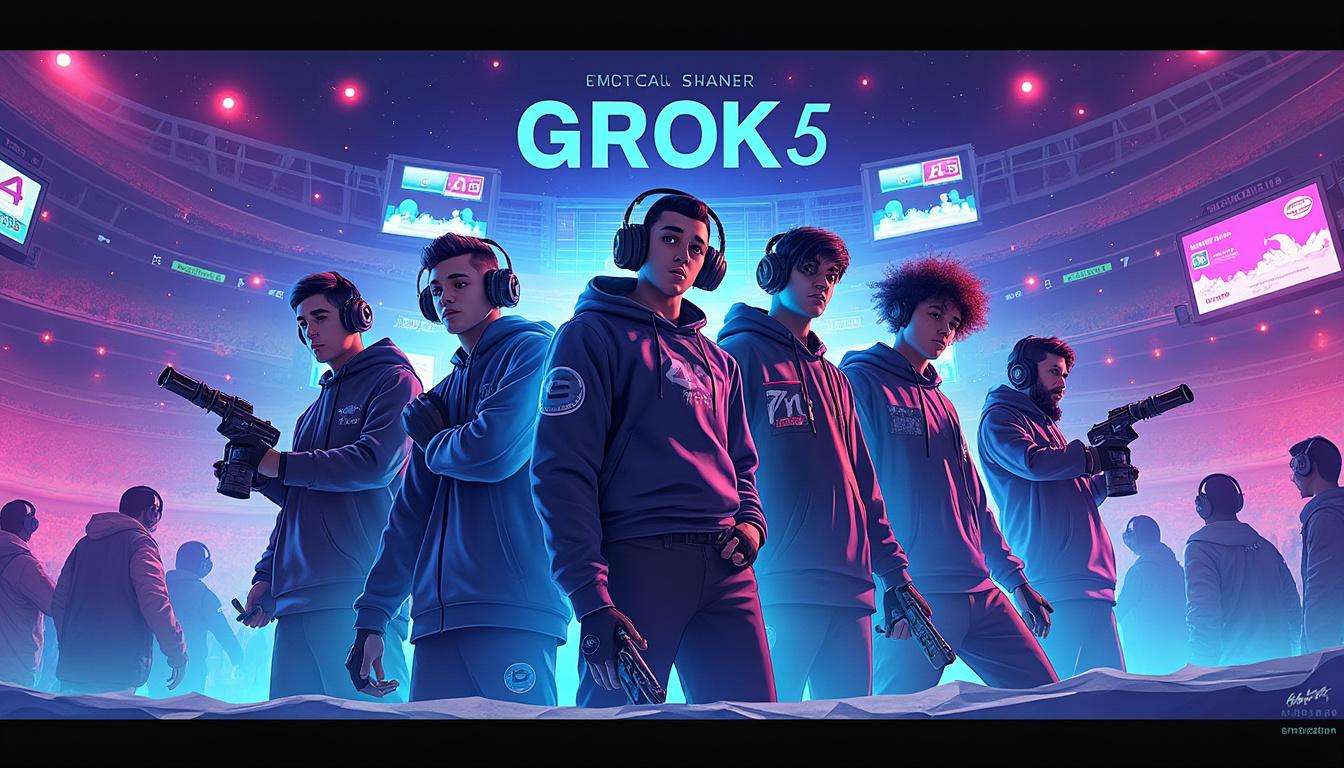
Summary: Elon Musk’s xAI project has publicly proposed a high-profile match pitting Grok 5 against the six-time world champions of League of Legends, T1. The proposed exhibition — a Bold Quest to Defeat the Greatest Team in competitive history — raises technical, strategic and cultural questions across the Esports scene.
Brief: As a professional player, I break down the practical rules, the strategic hurdles an AI must clear, and the likely impact on Competitive Gaming and Pro Players if an AI proves capable of matching top human teams in real conditions.
Grok 5 Challenge vs T1: Stakes and Context for the Gaming Challenge
The offer from xAI frames Grok 5 as able to “play any game” by reading rules and experimenting. Musk suggested strict human-like limitations — camera-only vision and human-standard reaction latency — to ensure a fair test against T1. Riot’s leadership and pro teams have already responded, making this a real-world event possibility rather than a hypothetical debate.
- Key actors: Grok 5, T1, Riot Games, and top Pro Players.
- Proposed constraints: camera-limited view, human-equivalent reaction time, and possibly robot actuation for input.
- Public interest drivers: viewership potential, commercial sponsorship, and competitive legitimacy.
Example: after T1‘s latest Worlds victory, community attention spiked; organizers see both an entertainment draw and a technical benchmark. This match would be a litmus test for AI in high-level team-based multiplayer games.
Technical Rules and Fair Play Constraints for a Valid Match
Designing a fair contest requires rule clarity. Musk proposed that the AI can only ‘see’ the monitor via camera and have reaction timings similar to humans. Riot’s involvement suggests any official event would codify telemetry, input methods and anticheat monitoring.
- Vision: camera feed limited to 20/20 visual equivalent for the AI.
- Input: robotized mouse/keyboard or simulated device that matches human ergonomics.
- Latency and telemetry: strict parity with player performance metrics used in pro matches.
As a pro player, parity in input and perception is non-negotiable; differences there would invalidate competitive claims. A clear, enforceable rule set is essential for legitimacy.
Why League of Legends Poses a Unique Strategy Problem for AI
League of Legends is not just mechanical execution; it is a persistent, evolving strategy game where individual actions are tightly coupled to long-term team plans. Previous AI demonstrations (for example, OpenAI’s Dota experiment) showed promise, but Riot’s title amplifies the importance of shared context, hidden information, and adaptive team synergy.
- Hidden state and information asymmetry: vision limitations and fog of war demand inference and prediction.
- Team coordination: executing multi-agent strategies under variable enemy responses.
- Meta evolution: itemization and patch-driven shifts that require continuous learning.
Case study: pro teams adapt across patches and events — the 2025 competitive season introduced new item changes that altered mid-game tempo, showing how rapid meta shifts can challenge even well‑prepared human teams. An AI must match that adaptability to legitimately contend.
Practical Limitations and Learning Path for an AI
Training a system to handle the full strategic depth of League of Legends demands continuous online learning, robust simulation environments, and safe exploration policies. In practice, developers need to reconcile experimentation with rules that prevent exploitative or non-human behavior during live matches.
- Simulation fidelity: accurate game-state models that reflect official patches and item interactions.
- Safe exploration: techniques to prevent catastrophic in‑match mistakes during learning.
- Human-like reasoning: planning horizons and prioritization akin to a seasoned shotcaller.
If these elements are implemented, the AI’s progress would be measurable; without them, the experiment would likely highlight gaps rather than breakthroughs.
Implications for Esports, Viewership and the Greatest Team
A successful AI challenge would ripple across the Esports ecosystem. T1, as the widely recognized Greatest Team with the sport’s most iconic player Faker, serves as the benchmark. A credible match outcome either way would reshape narratives about human uniqueness in high-level team play.
- Commercial impact: new sponsorship models and broadcast formats for AI vs human matches.
- Pro players’ careers: shifts in training focus, coaching, and public perception of value.
- Fan engagement: potential spikes in viewership similar to major Worlds finals.
For context, World Championship finals have reached multi-million concurrent audiences; any AI vs human spectacle could approach those numbers and force organizers to consider long-term regulatory frameworks for AI participation. This will influence contracts, training, and the role of coaching in future seasons.
Industry Signals and Ongoing Developments
Riot’s brief public engagement and T1’s curt “We are ready. R U?” reply show institutional interest. Meanwhile, the competitive scene continues to evolve with game updates and side projects that change the landscape.
- Riot and community events: new modes and cross‑media projects keep competitive formats dynamic; see recent coverage of the Esports Championship.
- Season and item shifts: patch and item changes are central to meta adaptation — read the Season 16 items overview for examples of balance effects.
- Related projects: spinoffs and crossovers such as Riftbound events influence fan attention; see Riftbound League of Legends coverage.
Insight: stakeholders must balance spectacle and sport integrity; credible rules and transparent tech audits will determine whether an AI match becomes a cultural milestone or a gimmick.
Match Format, Strategy and Viewer Experience for a Fair Test
Running a credible exhibition requires detailed format work: best-of series, enforced input parity, patch freezes and public telemetry. Riot’s involvement could standardize those aspects and ensure that both teams operate under identical technical constraints.
- Match structure: multi-game series with patch and item freeze to limit meta drift.
- Transparency: open logs, third-party auditors, and in-game telemetry dashboards for broadcasters.
- Broadcast presentation: educational overlays explaining AI decisions to viewers to preserve engagement.
Fans need tools to understand AI choices; a production that decodes an AI’s Strategy in real time will make the Gaming Challenge a meaningful spectacle rather than a technical demo.
Practical Steps Toward an Official Event
To move from proposal to event, stakeholders must agree on a roadmap covering patch selection, data access, and safety protocols. The community should expect iterative showcases before any official title match.
- Step 1: agree on patch and item freeze to avoid mid-series meta changes; relevant analysis available in patch notes and analysis.
- Step 2: establish input parity, possibly using certified robotic peripherals.
- Step 3: publish audited match logs and invite independent analysts.
Final insight: a staged approach with transparent rules and broadcast-oriented explanations will maximize legitimacy and viewer value for any Grok vs human showcase.
Resources and Cultural Context
For readers tracking the broader scene, recent articles and community features provide context on awards, seasonal changes and related projects.
- Event honors and recognition: see the Esports Awards 2025 winners for industry trends.
- Broader esports coverage: ongoing reporting on League of Legends esports keeps pace with format changes and team narratives.
- Adjacent IP and experiments: follow Riftbound and related content at Riftbound coverage.
Closing thought for this section: the debate over AI in competitive play sits at the intersection of technology, sport and culture, and careful stewardship will determine whether these experiments strengthen or disrupt the ecosystem.